

Creating and launching your first online course can be tricky.
Choosing the right online course topic is one of the biggest challenges aspiring course creators face. Many people get stuck at this stage, overthinking their ideas and delaying progress before they ever begin building their course. This guide is designed to help you move past that roadblock.
Rather than offering vague advice or surface-level motivation, this resource walks you through how to stop overthinking and choose a profitable online course topic—one that aligns with your expertise and has real market demand.
This guide walks you step by step through how to choose a profitable online course topic by focusing on three essential factors: passion, demand, and clarity. When these elements are aligned, you dramatically increase your chances of creating and launching an online course that sells. Get started with my FREE 5 Part Universal Course Framework.
Why Most Online Courses Never Get Created
One of the biggest obstacles to online course creation happens before recording ever begins.
Many people get stuck asking:
- What should I teach?
- Is this topic good enough?
- Will anyone actually buy this?
The result is analysis paralysis. Instead of moving forward, the course idea stays in your head—or in a half-finished outline—for months or even years. Check out my FREE Workshop: How To Choose A Course Topic.
While it’s true that you likely already have the expertise to teach something valuable, choosing a topic strategically matters. Creating an online course requires a significant upfront investment of time and energy, and it’s reasonable to want confidence that the effort will pay off.
The Importance of Choosing a Course Topic That Will Sell
Not all expertise translates into a profitable online course.
A strong course topic must meet two criteria:
- You are qualified and motivated to teach it
- There is proven demand for the topic in the market
Without both, even a well-produced course can struggle to generate sales.
The goal is not to convince people they need your course. The goal is to create a course around a problem people are already actively trying to solve.

My Background and Why This Matters
Before teaching others how to create online courses, I spent ten years as a middle school math teacher. Despite having a master’s degree, my income was limited, and financial stress was constant.
I eventually started a food blog alongside my teaching job in an effort to create passive income. After several years, that blog allowed me to leave the classroom—but financial stability was still a challenge.
It wasn’t until I identified a specific, unmet demand within the blogging space that everything changed.
Food bloggers were consistently struggling with one topic: keyword research. It was something I was skilled at, enjoyed teaching, and saw repeated demand for across online communities.
That insight led to the creation of my first online course.
In its first year, that single course generated over $83,000. Since then, my total course revenue has grown to well over $300,000.
The lesson was clear: choosing the right course topic makes all the difference.
Confidence Comes From Action, Not Perfection
Many aspiring course creators delay launching because they don’t feel “ready.”
The reality is that confidence is built through action—not before it.
Waiting until you feel completely certain often results in never starting at all. Strategic topic validation allows you to move forward with confidence, even if some uncertainty remains.
The 3-Part Framework for a Profitable Online Course Topic
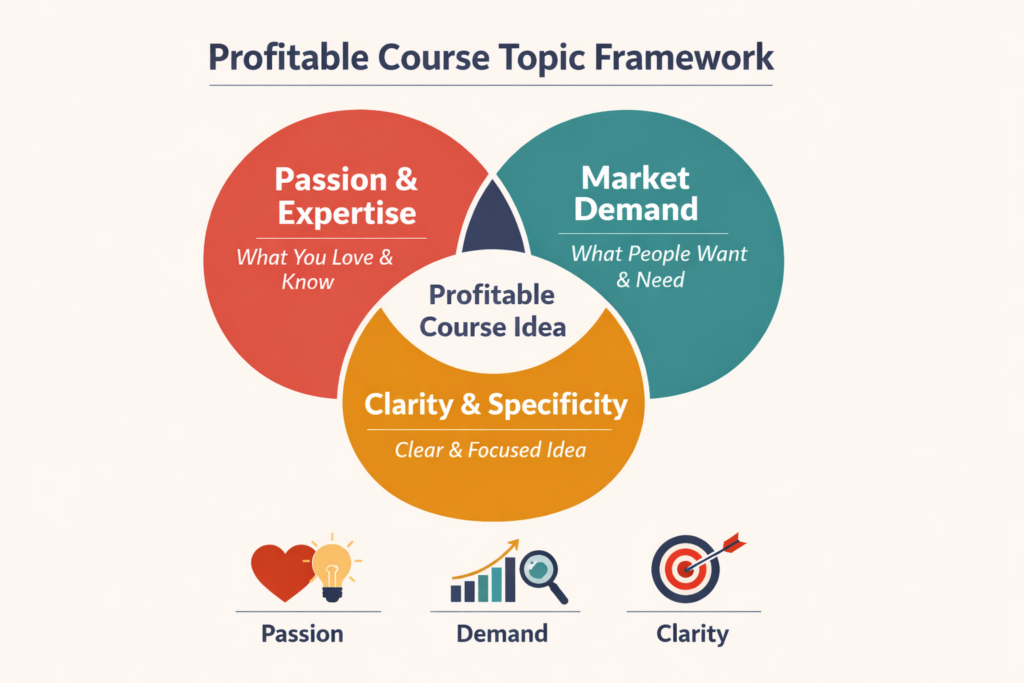
Every successful course topic sits at the intersection of three elements:
Passion + Demand + Clarity = A Profitable Online Course
Each component plays a distinct role in ensuring your course is both sustainable for you and valuable to your audience.
1. Passion: What You Can Sustain Long-Term
Passion is not just about what you enjoy doing—it’s about what you enjoy helping others do.
Ask yourself:
- Could I teach this topic repeatedly without burning out? (This is why passion trumps expertise)
- Is this a challenge I’ve overcome and can guide others through?
A course built solely on skill without interest often leads to disengagement over time. Long-term success requires both competence and a genuine interest in teaching the subject.
The goal is to find the overlap between what excites you and what allows others to achieve meaningful results.
2. Demand: Proof That People Want This
Demand is what separates a hobby topic from a profitable course idea.
If there is no existing interest, you will be forced to convince people why they need your course—a much harder sell.
Instead, look for evidence that people are already searching for solutions.
Ways to Validate Demand
- YouTube: Search your topic and review view counts on recent videos
- Facebook groups and forums: Look for repeated questions and frustrations
- Reddit and Quora: Identify common problems and unanswered threads
- Existing courses or paid products: Competition indicates a paying market
- Keyword research tools and Google Trends: Confirm consistent, evergreen interest
If you are choosing between multiple ideas, prioritize the one with the strongest demand first. Additional ideas can always become future courses.
3. Clarity: Specific Topics Convert Better
Clarity is often the most overlooked factor—and the most important. Broad course topics struggle to convert because they fail to communicate a clear outcome. For example, “Crocheting for Beginners” is vague. It doesn’t tell the buyer what they will actually achieve.
A simple test: If you cannot clearly explain who your course is for, what problem it solves, and what result it delivers in one sentence, the topic needs refinement.
As the saying goes: If you’re speaking to everyone, you’re speaking to no one.
Why the Transformation Is What Sells Your Course
People do not purchase courses for information alone. They invest in transformation or what you PROMISE they will walk away with,.
Your course must promise a clear, tangible result that students can recognize when they reach this result. So saying, “You will become a better gardener”, is not a measurable promise. That’s very subjective and vague.
Instead, saying, “You will learn how to plant a vegetable garden in 1 week using just $100.” (Now THAT’S measurable).
Here is a helpful framework to follow that I teach my students. Try to fill in the blanks…
My course helps [who] go from [problem] to [result] in [timeframe].
If the result is measurable or clearly defined, it increases perceived value and students know exactly what they’re going to get. So they’ll pay.
Determining If You’re Ready to Build Your Course
Before moving into course creation, you must make sure that you have the following:
- A system, framework, or method to teach your expertise
- A plan for recording lessons
- A course platform has been selected
- An email list or audience-building strategy
- A strategic launch plan
- Confidence in your expertise
- A realistic time commitment
- The tools to do get it done
If several of these are unclear or not decided on, then you’re not truly ready for course creation.
Final Thoughts
Choosing the right online course topic is not about sharing EVERYTHING you know about that topic. In fact, that’s what causes creators to fail. Instead, it’s about aligning your expertise with demand and communicating a clear specific outcome.
When you focus on passion, validating the demand, and defining a specific measurable result, you second-guessing yourself.
One of my recent courses, 20 Day Course Builder was designed for creators just like you. In the course, walk you through the proven process to help you go from idea to finished course with confidence from someone who has over 15 years of experience as a teacher and course creator. Learn more about the 20 Day Course Builder here.